50-years-unstoppable
Agricultural machinery
Digital Solutions
Service & Parts
Experience
Press
About CLAAS
50-years-unstoppable

50 Years of JAGUAR: an unstoppable success story

The JAGUAR

Ever since its launch in 1973, the JAGUAR has ensured that farmers can produce chopped material with maximum efficiency. In fact, it was the entry of CLAAS into the self-propelled forage harvester market 50 years ago that established the first milestone in enhanced efficiency. The success story began with the then pioneering JAGUAR 60 SF model.

Since then, a programme of continuous development has kept the JAGUAR in the top league of the forage harvester segment. A key objective of this development activity has always been the enhancement of the machine's core functionality:

increasing the throughput. In 1977, the second model – the JAGUAR 70 SF – was already achieving 75 tonnes per hour. From then on, the JAGUAR's performance attained ever greater heights. Today, the JAGUAR's throughput is over five times as high, reaching as much as 400 tonnes per hour.

But development measures that deliver continuous increases in the chopping speed are only part of the story – the CLAAS JAGUAR has always stood for progress that is far more than just a matter of sheer power.

Fuel efficiency: high throughput with low consumption

Along with a forage harvester's work performance, the efficiency of its fuel consumption plays an essential role in its cost-effectiveness. This is another factor which CLAAS recognised and addressed at an early stage. Starting in 1983, the JAGUAR used a new Mercedes-Benz engine design whose high torque ensured significantly reduced fuel consumption.

From 1994, an innovative engine layout – featuring a transverse power plant and a central radiator – cut the consumption of the already fuel-efficient machine once again.

Fuel efficiency: high throughput with low consumption

Today, electronic and digital components are largely responsible for the JAGUAR's fuel efficiency. Introduced in 2018, DYNAMIC POWER matches the engine performance curve to the prevailing operating conditions, reducing fuel consumption under partial load by almost 11 %. On top of this, a tyre pressure control system protects the soil, makes the operator's task easier and even increases traction. Introduced in 2019, the CEMOS AUTO PERFORMANCE assistance system greatly reduces the JAGUAR operator's workload so that the machine can be used efficiently all day long. This system can be programmed with maximum engine output and ground speed settings which it adjusts automatically in accordance with variations in the crop volume encountered in the course of harvesting.

This allows the engine load to be optimised while operating as fuel-efficiently as possible. Savings of up to 12 % can now be achieved with this system. Automatic control of the DYNAMIC COOLING fan speed ensures that only the required degree of cooling is provided. Accelerator gap setting completes the array of efficiency features and delivers an additional power saving of up to 25 kW.

The operator: the JAGUAR is a comfortable and convenient workplace

It was clear, right from the market launch of the JAGUAR, that the development activity had to focus on the operator – as it is ultimately he who literally holds the levers of power (not to mention the steering wheel). Then, as now, the designers recognised the need to make his workplace as comfortable and convenient as possible. The guiding principle was that an intuitive control concept and a well thought-out working environment should allow the operator to concentrate on his key tasks.

Already in the 1970s, CLAAS was fitting the CLAAS automatic steering system in the JAGUAR to reduce the operator's workload. 1991 saw a particularly significant milestone in the form of the innovative cab concept in the JAGUAR 695 MEGA, with which CLAAS set new standards for spaciousness, comfort and user-friendliness across the industry. CLAAS continues in this pioneering role to this day: the cab of the JAGUAR is one of the quietest in the market.

As with fuel efficiency, when it comes to making the operator's task as convenient as possible, it is above all the digital systems that have the greatest impact today. Some examples: CEBIS, the CLAAS electronic on-board information system, can also be found in other CLAAS combine harvesters and tractors today. AUTO FILL makes filling forage trailers easier: the position of the discharge chute is adjusted automatically, allowing the operator to keep looking ahead, and the number of clicks required on the control lever is halved. The operator's workload is also reduced by CAM PILOT and AUTO PILOT which steer the machine themselves. As a result, steering wheel movements are reduced to a minimum, dropping by up to 65 %. And if harvest conditions should become more challenging, CEMOS AUTO CROP FLOW automatically stops the crop flow in the event of an overload, thereby helping to keep downtime to a minimum.

Simple maintenance, FIRST CLAAS SERVICE and guaranteed reliability

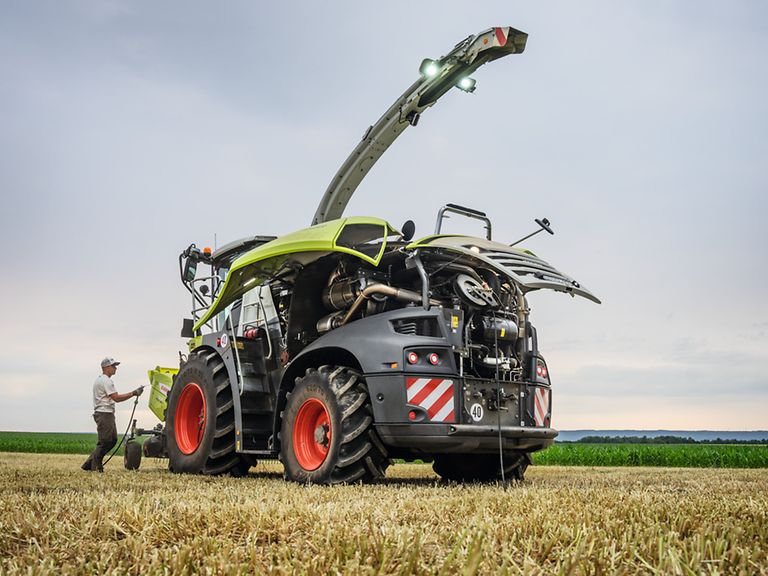
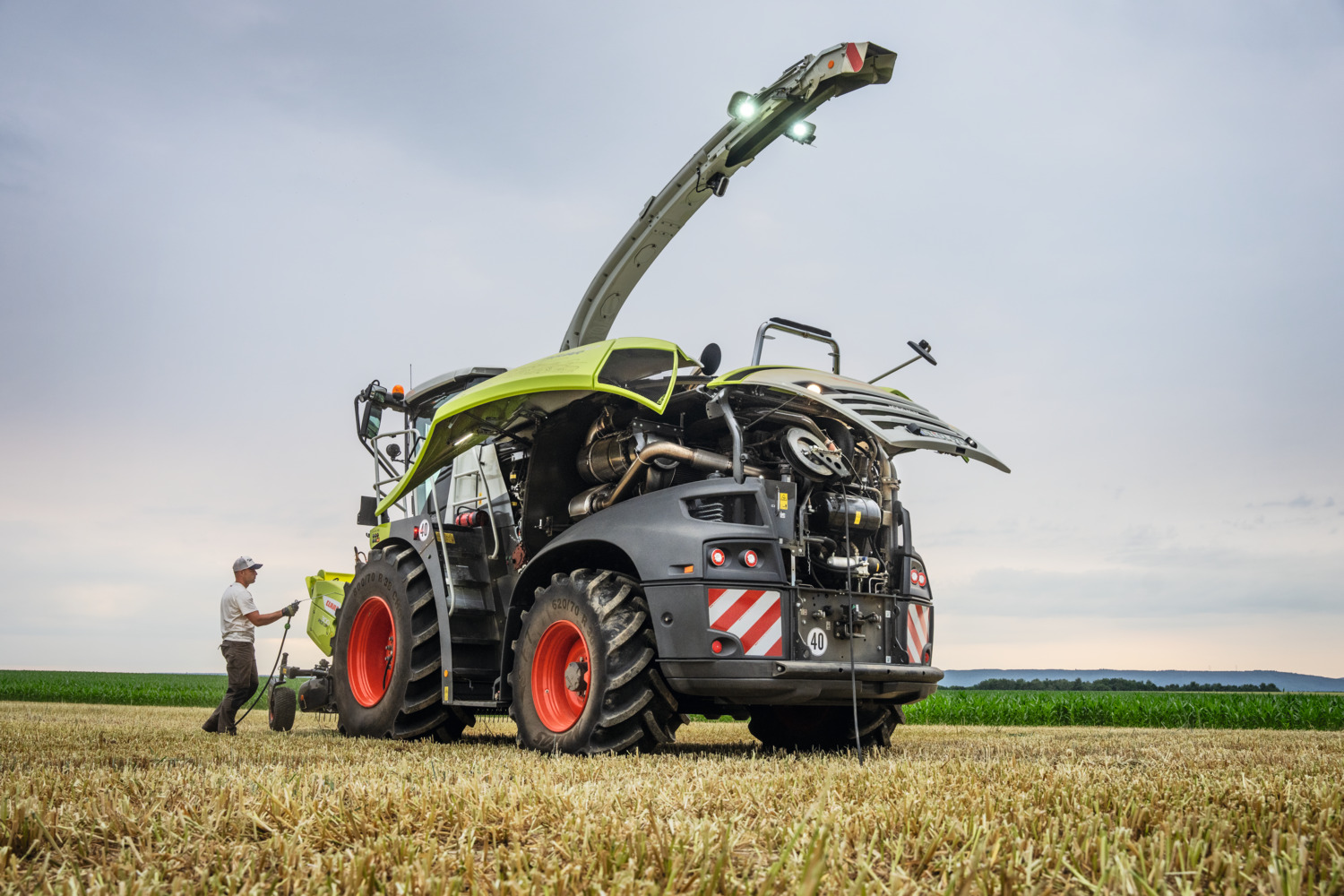
The JAGUAR is designed to be simple to maintain to keep downtime to a minimum and so ensure that it is always ready for action. Good accessibility and a central lubrication system with few manual lubrication points mean that maintenance never takes long. On the 900 model series, for example, each knife is attached directly to the V-MAX cylinder by means of just two bolts. The knives fit so precisely that they do not need to be aligned with the shear bar – a design feature that helps save valuable time.

If a repair is ever needed, a quick message is all it takes to contact the highly qualified service organisation. CLAAS offers a worldwide fast parts service for the JAGUAR. Using REMOTE SERVICE, you can benefit from even shorter downtime as the system proactively takes care of scheduling maintenance work for you.