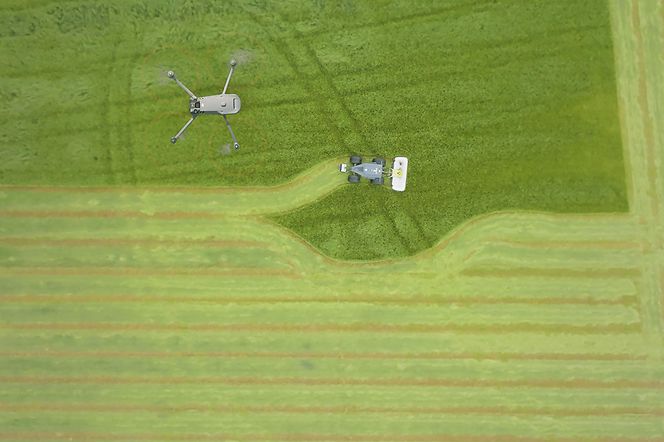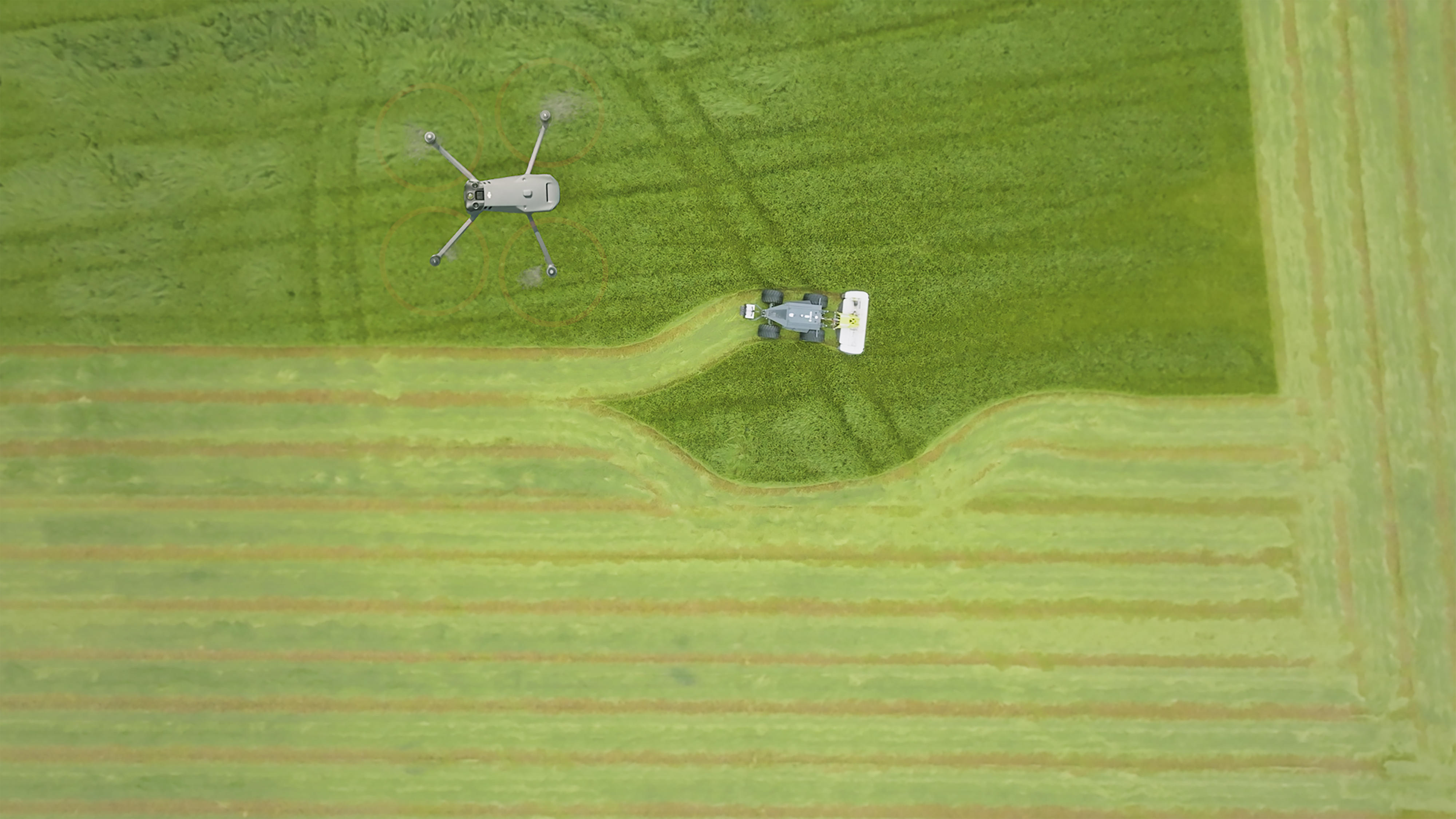
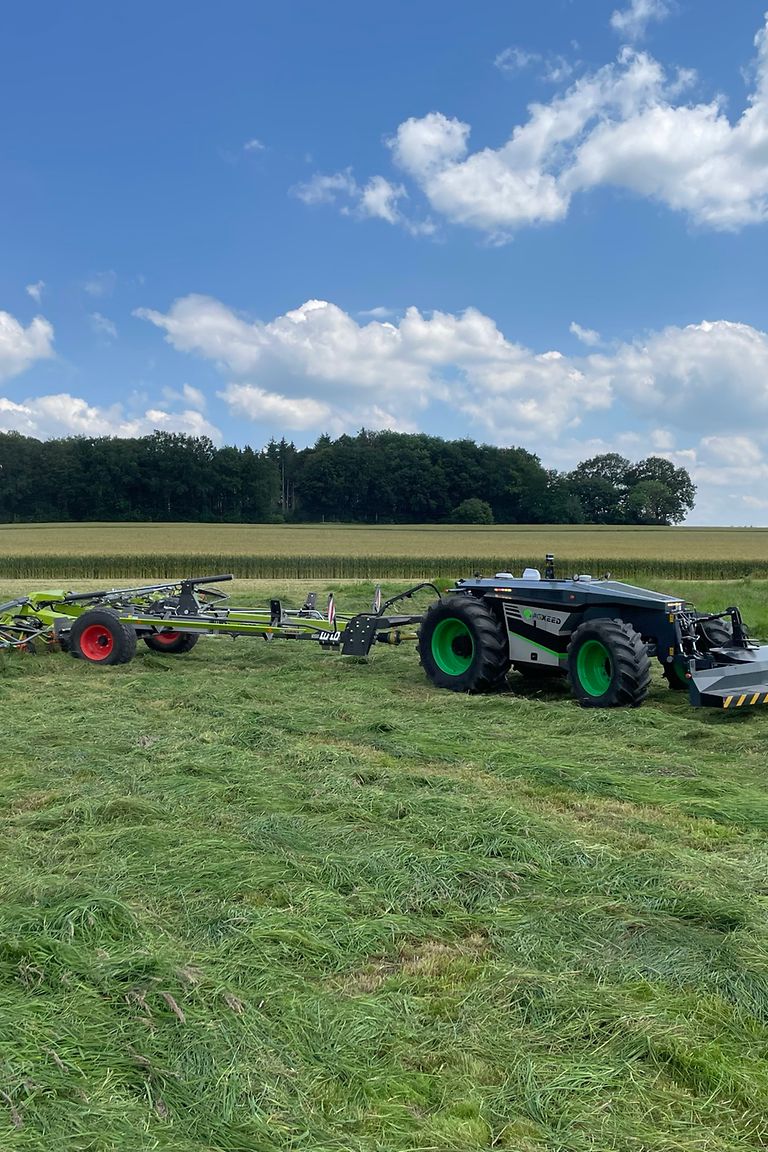
Forage harvesting is one of the most labour-intensive phases on many farms, especially the high-yielding early cuts. Before and during mowing, fields must be searched or scanned for wildlife – with operations such as mowing, tedding, swathing and clearance often going on at the same time. In future, autonomous tractors or AgBots will be able to lighten the workload for many farmers and contractors. Tall-growing crops present a particular challenge, as does the continuous monitoring and assessment of work quality. Together with partners such as AgXeed and thermal DRONES, CLAAS is researching and testing different areas of application as the basis for further progress in development and standardisation.
A question of interface: highly automated and autonomous mowing with wildlife rescue by drone
Drones with thermal-imaging cameras are now a widespread, safe and effective means of detecting breeding nests and wildlife, especially roe deer fawns, just before mowing grassland or whole-crop silage. The search is generally conducted using a live image and paused when a heat source is picked up to enable helpers to remove the animal to a safe place or mark its location or that of a nest.
CLAAS, thermal DRONES and AgXeed have already pooled their expertise and developed a joint drone interface for autonomous mowing. Heat source data obtained during the drone flight are initially stored, then processed with AI software and transferred with the associated GPS position data to the process planning tool. This incorporates the data into route planning, enabling the autonomous mower to maintain a defined (and adjustable) safety buffer around the site of the fawn or nest. This detour is particularly useful in fields where protected birds are breeding, as these nests cannot be removed. Farmers and contractors can track the machine's progress live on their smartphone, tablet or PC via the AgXeed platform. In this way, the use of autonomous mower combinations can meet demands for wildlife-friendly and sustainable grassland management as well as high area output. Furthermore, farmers can document measures taken before mowing to comply with obligations to provide supporting documentation.