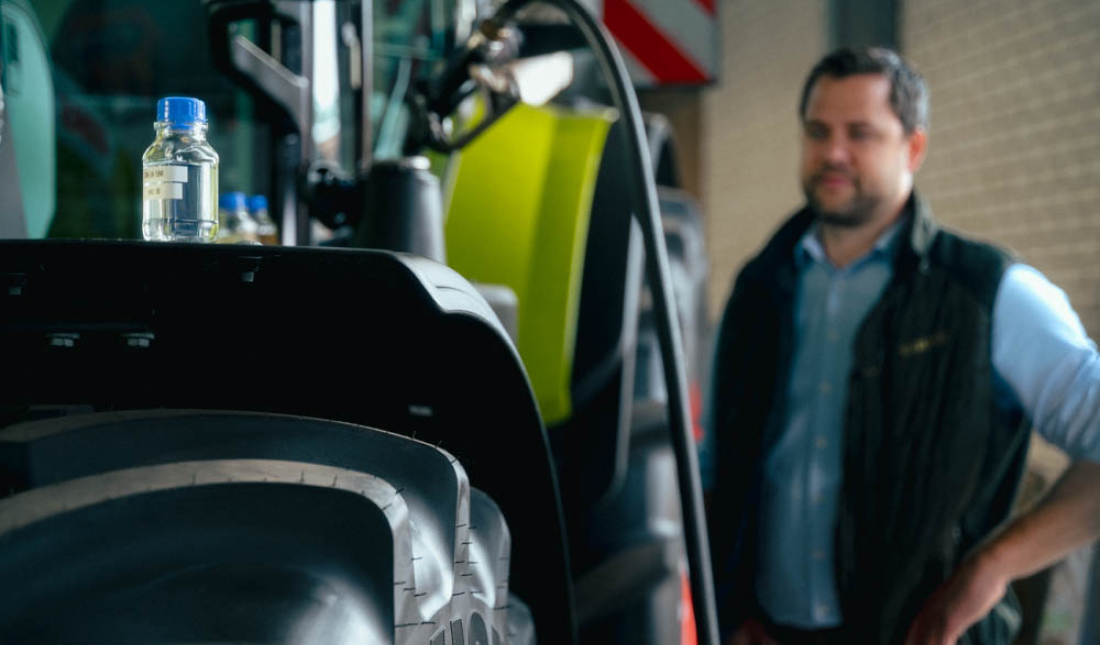
Internal combustion engines are often at the heart of debates surrounding climate change and sustainability. “It’s not the engine that’s the problem, it’s the fossil diesel,” explains Patrick Ahlbrand, product strategist at CLAAS.
While the electric drive is now an established alternative to combustion engines for road transport, it is not feasible in the foreseeable future in energy-intensive agricultural sectors for one simple reason: a battery-powered forage harvester, for example, would be twice as big, twice as heavy and therefore cause much more damage to the soil. The reason behind this is purely down to physics: batteries have a much lower energy density than liquid fuels.
Download "Efficient Farming" white paper
Complete diesel substitute from leftover and waste materialsOne promising approach to the decarbonisation of agriculture is the use of sustainable liquid fuels such as HVO (hydrotreated vegetable oil). HVO is an immediately available, low-investment option that can significantly reduce CO2 emissions from agriculture – without the need for any modifications, investments or new machinery.
HVO is produced through the chemical treatment of waste products such as plant residues or used cooking oil. Unlike traditional biodiesel made from rapeseed or other vegetable oils, this fuel does not compete with the production of food or animal fodder. This reduces CO2 emissions by up to 90 per cent. When the fuel is burned, it releases only the same amount of CO2 into the air that the plants previously extracted from the air as they grew.
Advantages for agricultural machineryCompared with the use of electric and hydrogen propulsion, HVO is straightforward and cost-efficient, especially for applications that demand high performance and long operating hours. Battery-driven vehicles are not currently suitable in this regard.
“Agriculture will continue to be dependent on large, powerful and efficient agricultural machinery with internal combustion engines in the future in view of the shortage of skilled labour and the need to increase productivity,” believes CLAAS expert Ahlbrand. Battery power is an alternative for small tractors up to 150 hp. “However, for medium- to high-power machinery, sustainable liquid fuels will remain essential,” says Ahlbrand.
In terms of overall economy, HVO already offers opportunities: if a medium-sized agricultural business switches completely from fossil diesel to HVO, no investment in infrastructure is required at all. They can simply continue to use their existing diesel pumps. However, if they want to use both fossil and sustainable fuel, they will need a second pump. “This may cost around €8,000, depending on the design, which is still manageable,” says Ahlbrand, compared to “the €40,000 that farmers plough into the installation of charging infrastructure for electric vehicles – and many times more for a hydrogen refuelling facility.”