Agricultural machinery
Digital Solutions
Service & Parts
Experience
Careers
Press
About CLAAS

South Africa

Regenerative, soil-friendly and precise

Cereal cultivation proved such a challenging undertaking that by the late 80s many Overberg farmers found themselves saddled with high debts, low yields and rising costs. A rethink was needed. At the same time, Heinrich Georg Schönfeldt took the bold step of striking out on his own, becoming one of the first in his region to switch to no-till and regenerative farming. In short, he abandoned his tillage implements in favour of direct drilling equipment. He left crop residues lying on the surface of the soil instead of burning off the stubble and established an annual crop rotation system in his fields. Today, almost 40 years later, his own farm runs to 3,200 hectares and he manages 6,000 hectares in total. Heinrich Georg Schönfeldt grows wheat, barley and oilseed rape conventionally on 5,000 hectares and various cover crops on the remaining land. These are harvested and delivered to a feeding station where they provide winter forage for his 1,500 cattle. For the remainder of the year, the stock are turned out on the stubble fields.

In search of alternatives

He learned about this cultivation system while abroad. After studying agriculture, Heinrich Georg Schönfeldt worked on farms in America, Australia and New Zealand to begin with. "I had witnessed the progressive soil degradation in my homeland and was looking for alternative farming practices and solutions to make our barren soil more fertile and to produce higher, reliable yields," recounted the 63-year-old farmer. The limiting factors at the time were, and still are, average annual rainfall of just 400 mm, which falls almost entirely in the winter months, and an impoverished topsoil consisting of heavy clay soil, a quarter of which is stones, extending to a depth of just 30 cm and followed by a layer of stones. "Our main aim is to retain the topsoil and increase its water holding capacity. For this we need humus, which we build up through regenerative practices," he explains. So the once high-risk, low-yielding Overberg region has been transformed into an area with relatively stable grain production and oilseed rape cultivation has significantly increased.
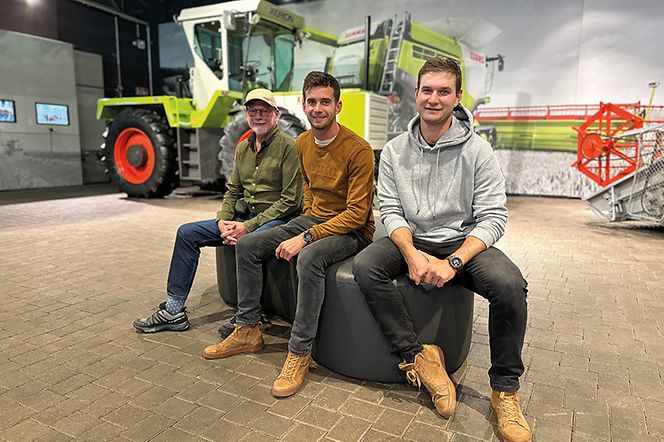
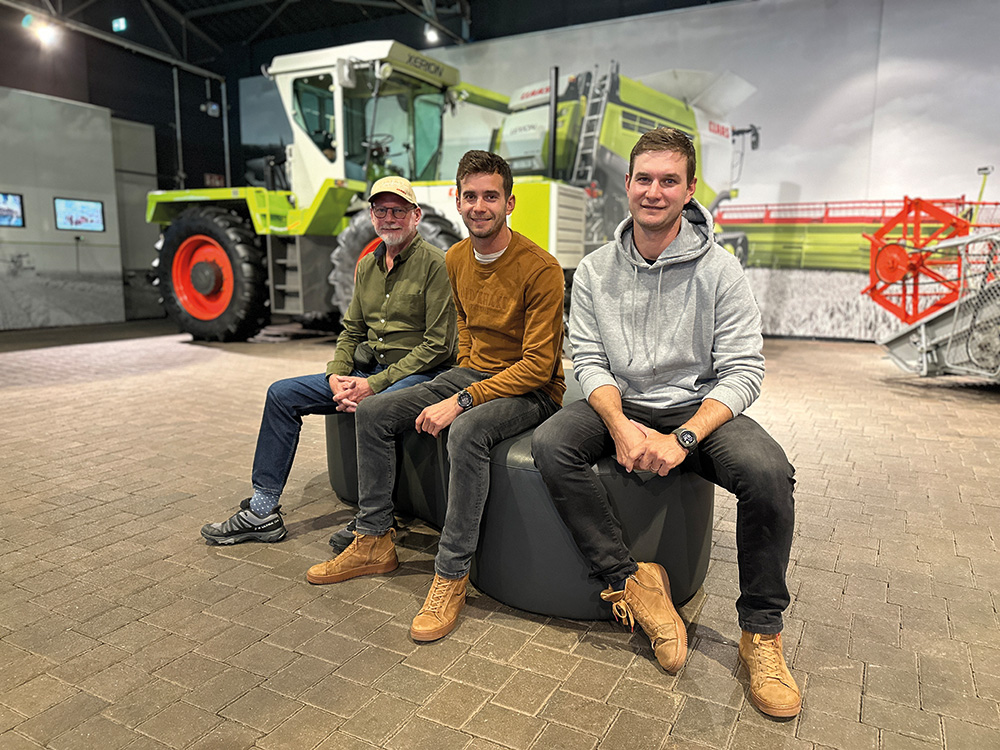
In mid-March, Heinrich Georg Schönfeldt (far left) and his sons Wilhelm and Hume visited the CLAAS factory in Harsewinkel. They were delighted to find the very first XERION – a 2500 from 1997 – at the CLAAS Museum.

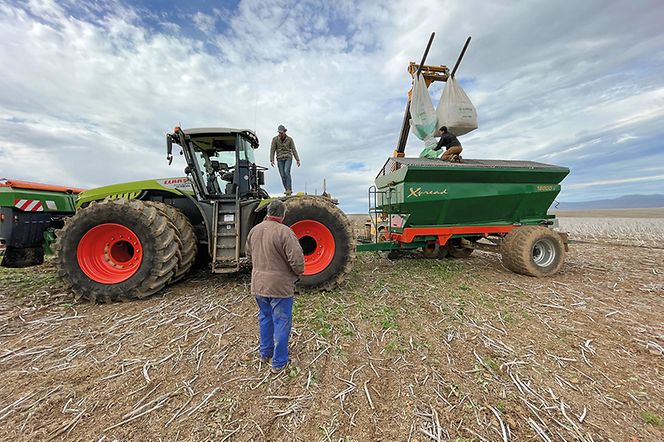
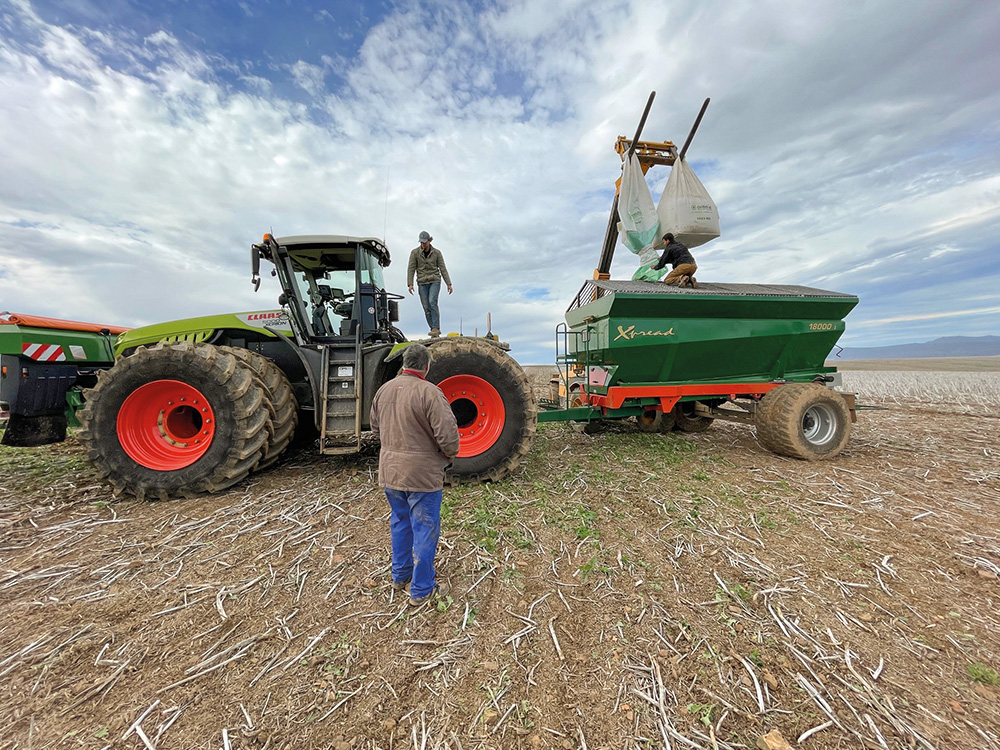
The fields and distances are huge, so mobile refill stations are needed for consumables such as fuel and lime.

Low producer prices and zero subsidies

Heinrich Georg Schönfeldt averages 2 t/ha of oilseed rape and has managed to increase grain yields to a stable 3.6 t/ha on average. That's good for his region. Nevertheless, business is not booming at present: "We currently get only around 8,500 Rand/t (approx. 420 euros/t) for our rapeseed and around 5,200 Rand/t (approx. 260 euros/t) for wheat and barley. At these prices we make a loss and what's more, there are no farming subsidies of any kind here." Two years ago, he was getting 10,500 Rand/t for rapeseed and 7,000 Rand/t for wheat and barley, which was enough to get by. The farm machinery is the only lever at his disposal with which he can influence his operating results in the relative short term.

Controlled traffic and precision farming

As a young man, he brought back another idea from his travels abroad, which he implemented only at a later stage – precision farming using the controlled traffic system. "In my view, precision farming is the key to greater efficiency and productivity in arable farming. On our huge fields we need the power and precision of large-scale, state-of-the-art equipment. But to make sure that the heavy weight of the machines does not negate our efforts to protect the soil, we switched to controlled traffic farming (CTF) six years ago," explains Heinrich Georg Schönfeldt. CTF means driving on permanently fixed tramlines at all times for all operations. This move was finally prompted by his 31-year-old son Hume's year in Australia, where CTF has been widely used since the 1990s. Hume works on the family farm, as does his brother Wilhelm, who is two years younger.

3.3 m track width with the XERION

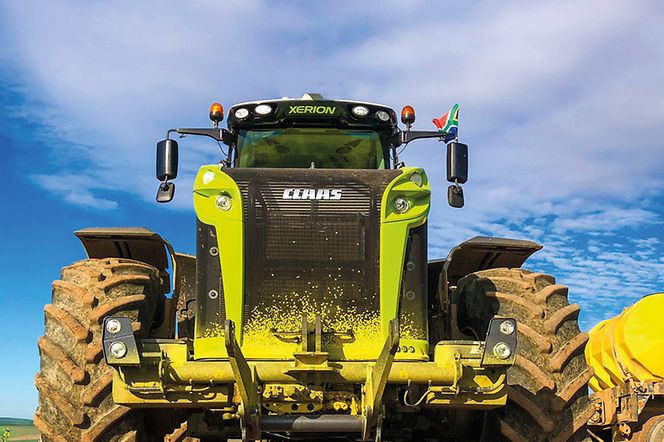
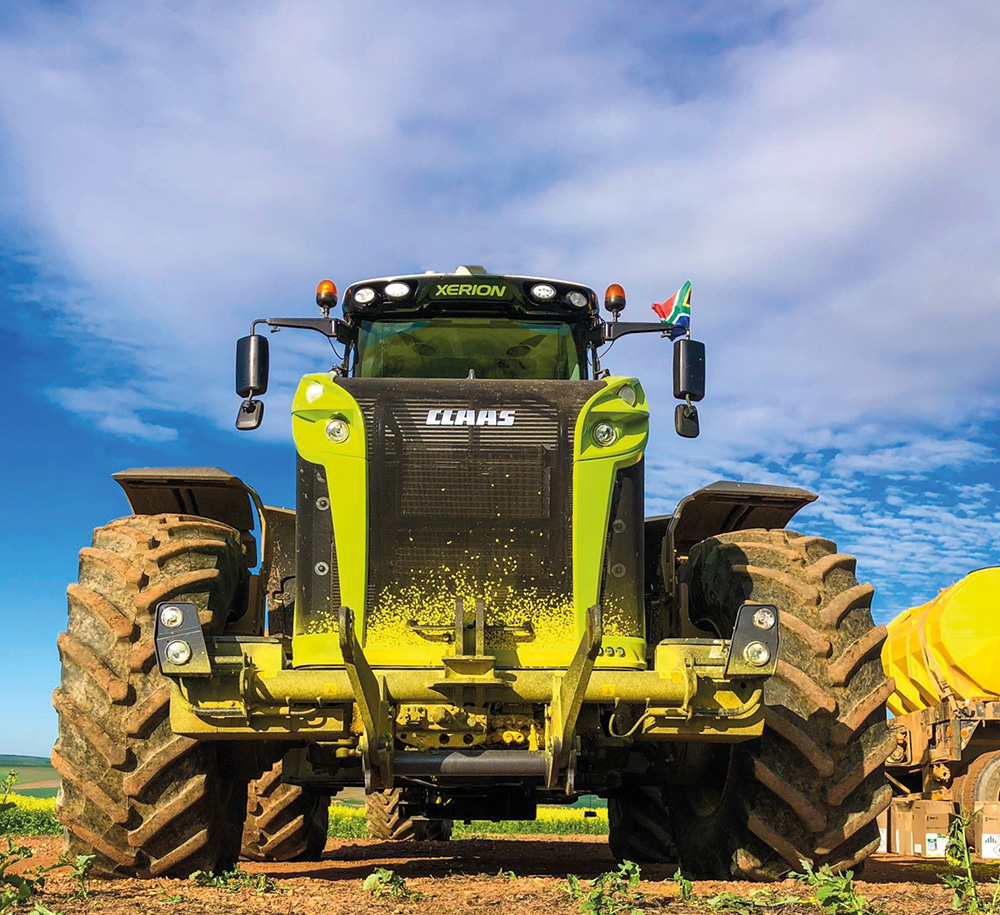
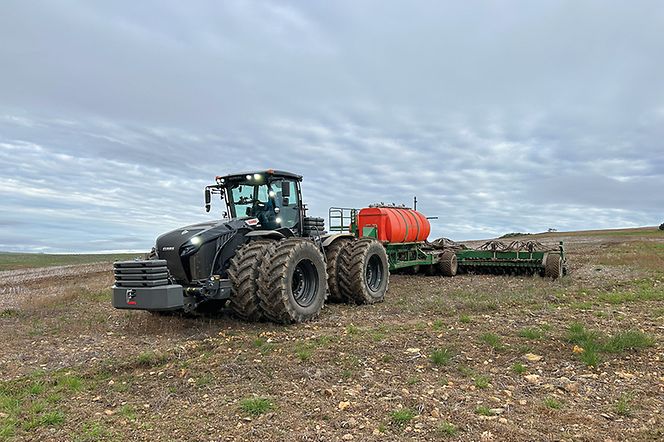
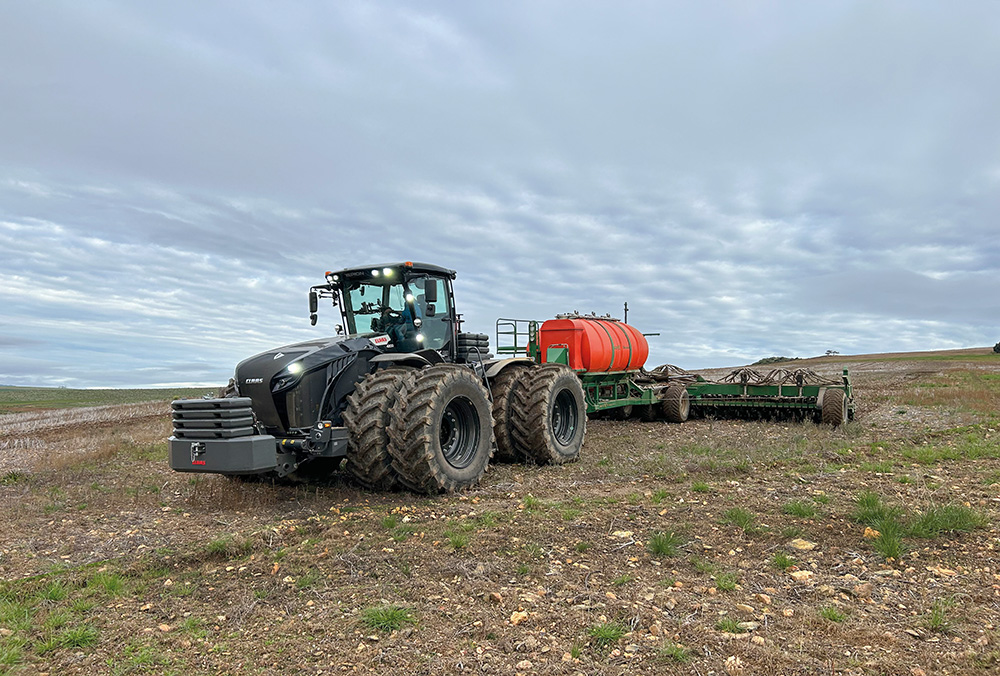
"We consolidated our land to create the largest possible fields and defined the optimal direction of travel in tramlines of 12 m with a track width of 3.3 m," explains Hume. The three then said goodbye to the articulated tractors with dual tyres they had previously used and matched all new tractors and implements to the wide track and working widths of 12, 24 or 36 m. "We opted for the CLAAS XERION. It is sufficiently stable for the 3.3 m track and its attached and mounted implements give us complete flexibility for all our fieldwork, from high-pressure baling to drilling (three 12-m direct drills), fertilising and liming (two 36-m fertiliser spreaders, one 12-m lime spreader) and spraying (three 36-m sprayers with a combined capacity of over 10,000 litres). And its fuel consumption is comparatively low," explains Wilhelm. What's more, the nearest CLAAS dealership, Overberg Agri based in Caledon, is just 15 km away.

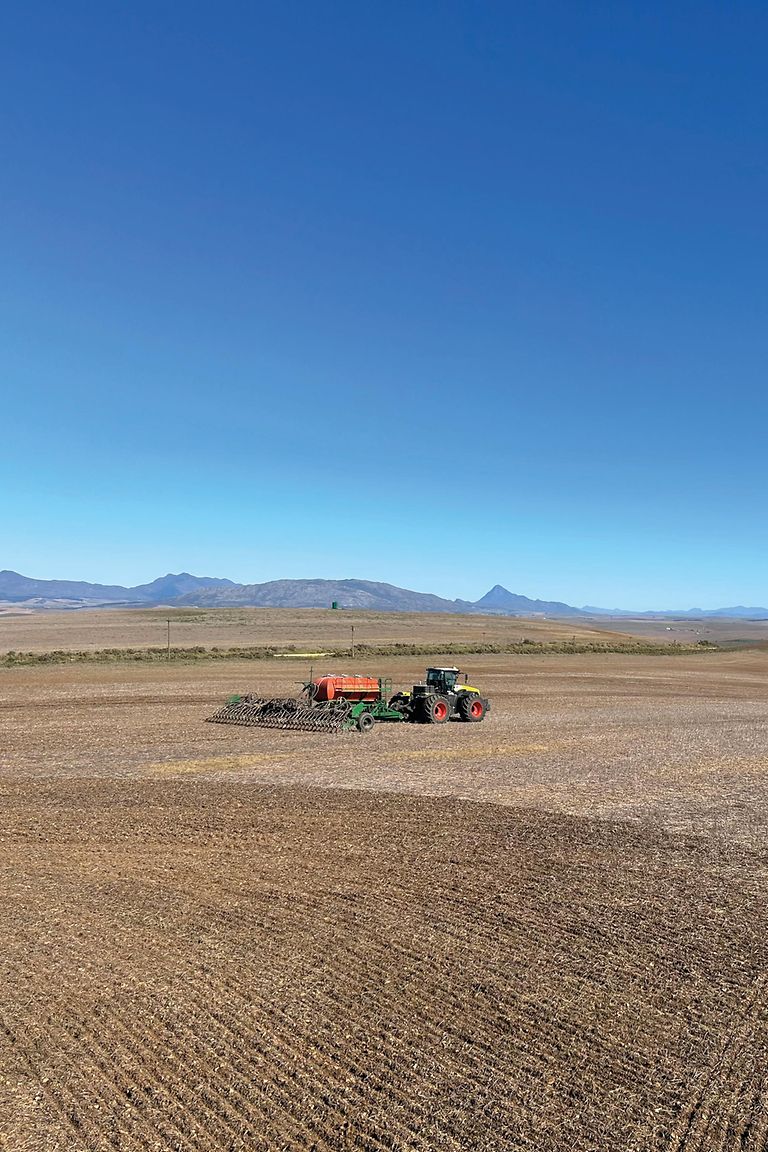
Six years ago, the farm switched to controlled traffic farming with 12-metre tramlines and a track width of 3.3 metres.

Stones and direct drilling are not a perfect match, but it works. On the Schönfeldt farm they work with three 12-m machines with double disc shears and a row spacing of 168 mm.

Trained operators are in short supply

Ride comfort for their staff and themselves was also a deciding factor, the older brother explained: "Our fleet is not exactly large and our working days are correspondingly long – 12 hours on average. So we take comfort very seriously. But by no means all of our 13 employees are tractor drivers. With the cattle and the workshop, there's plenty to keep them busy. The trouble is it's hard to find enough skilled operators to drive our state-of-the-art machines. So we end up spending a lot of time ourselves on the machines." The three men each have their own XERION. Hume drives the oldest, a XERION 500 from 2019 which has clocked up 4,000 operating hours, his father a XERION 5000 built in 2021 with 2,000 hours on the clock and lucky Wilhelm has the newest XERION, a 4200 with custom black paintwork. It was bought last year and has worked 700 hours to date. "Because CLAAS offers a three-year warranty on new machines, we aim to replace machines with new ones before the warranty expires," their father explains, although he admitted that they had yet to achieve this. At present, the business was not doing well enough, but he was standing by this strategy and prioritising machines still under warranty when it came to allocating work.

The same is true of their two standard tractors, the AXION 930 and ARION 620, and their three LEXION 8700. "By purchasing the three new LEXION, we were able to axe one combine harvester altogether. Another reason that persuaded us to switch to CLAAS was 3D and 4D cleaning; we now have far fewer losses when harvesting on slopes. You see, in Overberg it's not just dry and stony, it's also rather hilly," said Hume.

Data interfaces that work

All tractors and harvesting machines are equipped with an automatic RTK track guidance system from John Deere and the Climate FieldView farm management system from Bayer CropScience to achieve the necessary precision in CTF and for working with application maps – all factory-fitted by CLAAS. "The CLAAS RTK network is still in development here, but CLAAS provides the necessary data interfaces between CLAAS TELEMATICS and the other manufacturers. It works very smoothly," explains the father, adding: "We are considered very successful arable farmers in our region. Nonetheless, our profit margin is very low. Ultimately, to earn money, we have to farm more and more efficiently. That means large, state-of-the-art agricultural machines, and the only way we can utilise their full potential is to increase the size of our farm. A vicious circle, to be honest. That said, our land prices of around 115,000 Rand/ha (about 5,700 euros/ha) are far more affordable than in Germany, for example, and thanks to our large field structures, modern technology is also more feasible.